Guías
TFT Leveling Guide for Beginners
Hi im TFTtomus im Challenger EUNE/EUW server Ever since Set 2, I have been striving to share as much knowledge as possible—both through my broadcast channels and in video format on YouTube.

General Information
This guide covers the fundamentals of leveling in TFT, including when to buy experience, which levels to aim for throughout the game, and when to roll for 3-star units. These are some of the most important basics to understand if you want to improve consistently, build stronger boards, and make better decisions throughout your games. You gain 2 XP for free every round. You can also purchase 4 XP for 4 gold, which is the minimum amount you can buy at once. Leveling allows you to field more units, making your board stronger. It also increases your chances of finding higher-cost champions in your shop. One important thing to understand is how stages work. For example, 2-5 means Stage 2, Round 5. You can always find the current stage and round at the top of your screen.

Level 4 – Stage 2-1
This is your first important leveling decision, right after the first Augment.
If you don't have strong units, upgrades, or a promising combination, it's usually better to save your gold and maintain your economy.
However, if you already have upgraded units that synergize well with each other and can give them good items, leveling to 4 is a great option. You can play your strongest board and try to winstreak. This is what we call playing tempo.
Level 5 – Stage 2-5
If you're playing tempo and trying to maintain a strong board, you should generally level to 5 after the first carousel, on Stage 2-5.
Level 6 – Stage 3-2
You can usually wait until the second Augment, on Stage 3-2, before leveling to 6.
Sometimes it's worth spending more gold to stabilize your board, even dropping to around 30–40 gold, depending on your situation.
Level 7 – Stage 3-5 or 4-1
This depends on your economy, Augments, and overall game state.
If you have enough gold to maintain around 40 gold after leveling, you can go to Level 7 on Stage 3-5.
If your economy is weaker, it's usually better to wait until Stage 4-1, right after the Wolves.
Level 8 – Stage 4-2 or 4-5
Leveling to 8 follows a similar principle to Level 7.
If you have enough gold and can maintain around 30–40 gold after leveling, you can go to Level 8 on Stage 4-2, after the third Augment. From there, roll to stabilize your board.
If you're low on gold but have enough HP to survive, you can wait until Stage 4-5, after the carousel. This gives you better odds of finding upgrades while preserving more gold.
Level 9 – Depends on the Game
Level 9 is highly situational.
Sometimes you need to roll heavily on Level 8 to stabilize and secure a Top 4. In other games, your board is already strong enough that you can skip rolling and go straight to Level 9.
Depending on your economy and board strength, you might reach Level 9 on Stage 5-1, Stage 5-2, or even later on Stage 6.
Level 10 – Usually Economy-Dependent
Level 10 is generally achievable with strong economy Augments or special game mechanics that provide additional gold or experience.
It's important to remember that these timings are only guidelines. If you have extra gold, you can level earlier. If you're playing from a losing streak, you might want to delay leveling and focus on reaching 50 gold as quickly as possible.
These are standard leveling timings for games without additional XP mechanics or special bonuses. Even when those mechanics are available, try to follow similar timings and, whenever possible, level up with exactly 0 XP remaining. Sometimes you may need to adjust your timing by one round depending on your Augments or additional XP.

Reroll compositions focus on upgrading specific champions to 3-star. The optimal level for rolling depends on the cost of the units you're trying to upgrade.
The reason is simple: each level has different shop odds, meaning certain levels give you the highest chance of finding champions of a specific cost.
1-Cost Reroll – Levels 4 and 5
If you're playing a composition focused on 1-cost champions, you generally want to stay on Level 4 and Level 5 throughout the early game.
Avoid leveling during the early stages, as doing so reduces your chances of finding the 1-cost units you're looking for.
2-Cost Reroll – Level 6
For 2-cost reroll compositions, Level 6 is your primary rolling level.
You generally want to reach Stage 3-2, level to 6, stabilize your board if necessary, and then roll for your upgrades.
3-Cost Reroll – Level 7
If you're playing around 3-cost champions, Level 7 is the best level to roll.
You usually want to roll on Stage 3-5 or Stage 4-1, depending on your economy and how strong your board currently is.
4-Cost Carries – Level 8
If your composition revolves around upgrading 4-cost champions to 2-star, Level 8 is your main rolling level.
This is where you have the best odds of finding 4-cost units while maintaining a reasonable chance of hitting other champions that can improve your board.
5-Cost Units – Level 9
If you're looking to upgrade legendary 5-cost champions, Level 9 is generally the best level to roll.
You have significantly better odds of finding 5-cost units compared to Level 8.
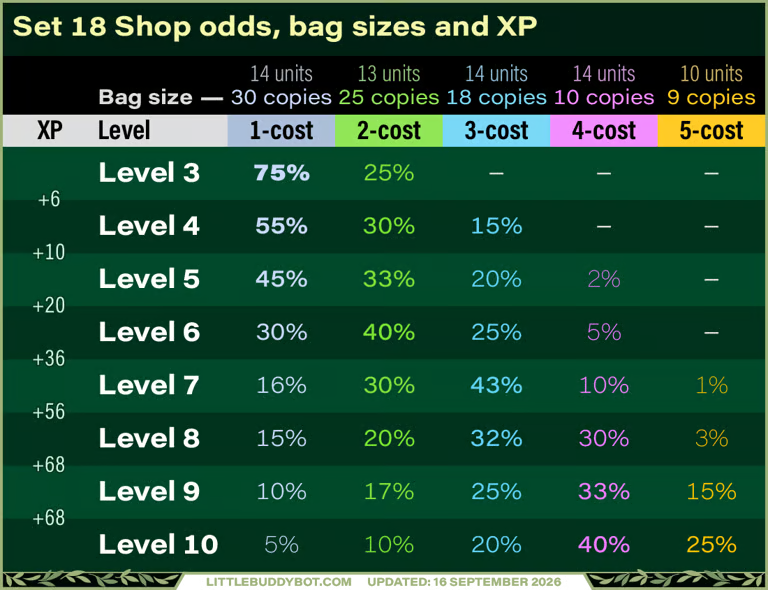
The main reason we roll at specific levels is that shop odds change with every level.
The higher your level, the greater your chance of finding expensive champions. However, this also means that your chances of finding cheaper units decrease.
You can always check the exact shop percentages directly above your shop in-game and I gave you a photo above!
Understanding these odds is one of the most important fundamentals in TFT. Once you learn which levels are best for each unit cost, you'll make much better decisions about when to roll, when to level, and how to manage your economy.
These fundamentals alone should help you improve significantly over your first few dozen or even hundreds of games.

Lleva lo aprendido a la práctica
Repasa las bases o entrena tu criterio con escenarios de partida.